


Learn how to play the A chord on guitar with this detailed guide… Find tips on finger placement, strumming, variations, and common mistakes to master the A chord with ease!
How to Play the A Chord on Guitar: A Beginner’s Guide
The A chord is one of the most essential chords for beginner guitarists, forming the basis for countless songs and chord progressions. Whether you’re just starting or looking to polish your skills, mastering the A chord on guitar will open up new possibilities in your playing. In this guide, we’ll cover everything you need to know about playing the A chord, from finger placement to variations and practice tips.
What is the A Chord on Guitar?
Understanding the A Major Chord
The A major chord consists of three notes: A (root), C# (major third), and E (perfect fifth). Together, these notes create a bright and harmonious sound that’s foundational in various genres, including rock, pop, country, and folk. Understanding these notes can also help you learn related chords, like A minor and A7, which have similar shapes and sounds.
A Chord Diagram and Finger Placement
To play the A chord, follow these steps:
- Place your index finger on the 2nd fret of the D string (4th string).
- Place your middle finger on the 2nd fret of the G string (3rd string).
- Place your ring finger on the 2nd fret of the B string (2nd string).
Make sure that all three fingers are on the same fret. For a clear sound, strum only the A, D, G, B, and high E strings and avoid the low E string.


Step-by-Step Guide to Playing the A Chord
Correct Finger Placement for the A Chord
Positioning your fingers correctly is crucial for producing a clean A chord sound. Begin by placing each finger close to the fret without overlapping. Curve your fingers slightly to avoid muting adjacent strings, and press down firmly for the clearest tone. Since all three fingers share the same fret, the positioning may feel tight initially, but with practice, it becomes comfortable.
Strumming the A Chord Correctly
The A chord is strummed by playing the A, D, G, B, and high E strings. Avoid strumming the low E string, as it can add an unintended bassy tone. Some players use their thumb to mute the low E string, providing extra control over the sound.
Common Challenges and How to Overcome Them
Finger Tightness and Overlapping
One of the most common challenges with the A chord is fitting all three fingers on the same fret. For some players, this positioning can feel tight or uncomfortable. Practice slowly, adjusting your finger angles to avoid overlapping or muting the strings. With time and practice, you’ll develop the flexibility needed to play the A chord comfortably.
Avoiding Muted or Buzzing Sounds
Muted or buzzing sounds often occur when fingers don’t press down firmly enough or when they accidentally touch neighboring strings. To fix this, apply consistent pressure with each finger and ensure that your fingers are curved. Keeping your fingernails trimmed can also help improve accuracy and sound quality.
Variations of the A Chord
A Minor and A7 Chords
Learning variations of the A chord, such as A minor and A7, will add versatility to your playing:
- A minor (Am): To play A minor, move your middle finger to the 2nd fret of the D string, removing your ring finger from the fretboard. This minor variation creates a softer, more melancholic tone.
- A7: To play A7, remove your ring finger from the B string, leaving your index and middle fingers in place. This adds a bluesy feel, ideal for jazz and rock.
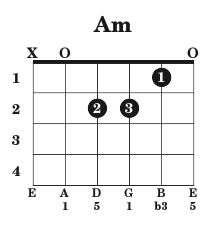

A Major Barre Chord on the 5th Fret
The A major barre chord on the 5th fret is an advanced variation that involves barring the entire 5th fret while forming an E chord shape with your other fingers. Barre chords require more finger strength, but they offer flexibility in moving up and down the neck and are essential for intermediate and advanced players.

Songs Featuring the A Chord
The A chord appears in countless songs, making it an accessible and rewarding chord to learn. Here are a few beginner-friendly songs that use the A chord:
- “Sweet Home Alabama” by Lynyrd Skynyrd
- “Wonderwall” by Oasis
- “Brown Eyed Girl” by Van Morrison
Practicing these songs will help reinforce your skills with the A chord while also building your confidence with smooth transitions.
Practice Tips for Mastering the A Chord
Using a Metronome to Build Timing and Rhythm
Using a metronome can help you build rhythm and keep a steady pace as you practice the A chord. Begin at a slower tempo to ensure accurate finger placement, and gradually increase the speed as you gain comfort and confidence.
Daily Finger Exercises for Flexibility
Dedicate 10-15 minutes daily to finger exercises to build strength, flexibility, and control. Exercises like the spider walk are great for improving finger independence, making it easier to play the A chord and transition to other chords.

Frequently Asked Questions (FAQ)
- Which strings do I strum for an A chord on guitar?
Only strum the A, D, G, B, and high E strings for a clean A chord sound. Avoid the low E string. - Why does my A chord sound muted or buzzy?
Muted or buzzing sounds are often due to insufficient finger pressure or fingers accidentally touching neighboring strings. Adjust your finger position and press down firmly. - What’s the difference between A and A7 chords?
The A7 chord is a variation of the A chord that creates a more open, bluesy tone. To play it, lift your ring finger off the B string. - Can I play the A chord as a barre chord?
Yes, the A chord can be played as a barre chord on the 5th fret. This variation is ideal for building finger strength and adds flexibility to your playing. - What are some songs that use the A chord?
Popular songs with the A chord include “Sweet Home Alabama” by Lynyrd Skynyrd and “Wonderwall” by Oasis.
Learning to play the A chord on guitar is an important milestone for any guitarist. With its common usage in various songs and chord progressions, mastering the A chord will provide a strong foundation for more advanced playing. Use these tips, from proper finger placement to exploring variations, to make your practice effective and enjoyable. Consistent practice will make the A chord feel natural, opening up more musical possibilities and taking your playing to the next level.


