


Here’s a fun secret: if you’ve ever played a 7th chord, you’ve been playing tritones all along — the famous ‘devil’s interval’ has been hiding inside your chord vocabulary the whole time, doing its job so smoothly you never noticed. This lesson is the practical companion to our tritone-interval explainer: less what it is, more where it lives on your guitar and how to use it on purpose — the movable shapes, the chords it powers, the classic two-finger blues grip that professionals comp with, and a ten-minute routine that turns theory into hands.
The Shape You Already Own: Inside Every 7th Chord
Grab an ordinary C7 (x32310) and meet your resident tritone: the E on the D string and the B♭ on the G string — six half-steps apart, ringing in the middle of the chord. That pair is why a 7th chord sounds restless where a plain major chord sounds settled: the tritone inside it is pulling toward resolution, and your ear hears the chord ‘wanting’ to move. Every dominant 7th chord you know — every shape, every key — carries this engine. The bluesy, unresolved, gotta-go-somewhere quality of 7th chords IS the tritone.

The Two-Finger Pro Move: The Blues Comp Shape
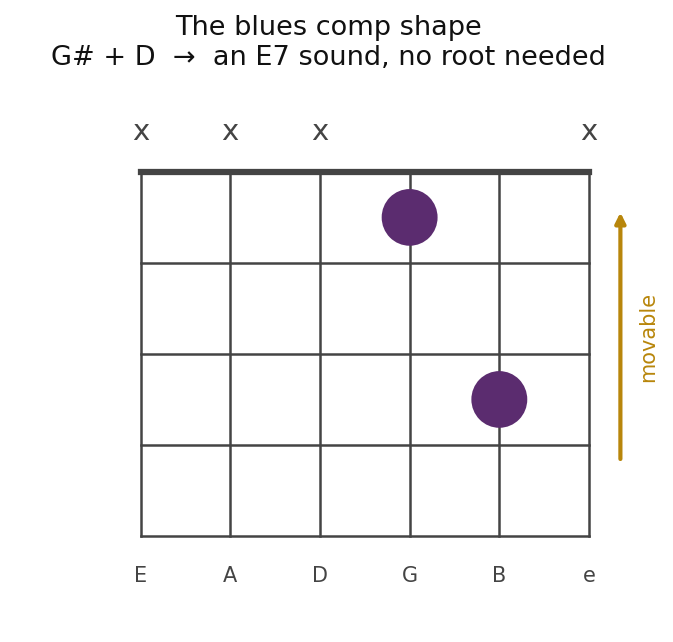
Now for the shape working guitarists actually reach for. Strip a 7th chord down to only its essential tension — the tritone itself — and you get a two-finger grip that says ‘7th chord’ all by itself: for an E7 sound, fret the G string at the 1st fret (G♯) and the B string at the 3rd (D). No root, no extras; the band’s bass covers the root, and your two notes supply the entire attitude. This little shape is a cornerstone of blues and jazz comping — small, movable, and punchy — and sliding it around the neck gives you a 7th-chord sound in any key for the price of two fingers. It’s also the classic gateway to a famous jazz trick (substituting one 7th chord for another that shares the same tritone) — file that phrase away for the day your playing goes looking for it.
The Tritone Factory: Diminished 7th Chords
If one tritone is tension, our old friend the dim7 chord is tension squared — because a diminished 7th is literally two tritones stacked. Play the Ddim7 from our diminished-and-augmented lesson (xx0101) and look inside: D against A♭ is one tritone, B against F is another, sounding simultaneously. That double dose is why diminished chords feel so urgently unstable, why they work so well as passing chords — and why the same shape repeats every three frets: stacked tritones are perfectly symmetrical. One shape, two tritones, endless dramatic exits.

| Where tritones live on your guitar: Inside every dominant 7th chord (the restless middle), as the two-finger movable comp shape (adjacent strings), doubled inside every dim7 — and anywhere you play two notes six frets apart. You’ve been fluent for years; now you know the word. |
Using the Tension on Purpose: A 10-Minute Routine
- Minutes 1–3 — hear the engine: alternate C major (x32010) and C7 (x32310) slowly. Same chord, one added tritone — listen for the ‘settled vs restless’ difference until you can name it blind.
- Minutes 4–6 — resolve it: play C7, then F major (or its bottom notes: C to E movement). Feel the 7th chord’s tritone let go into home — the classic dominant-to-home release, the most-used resolution in popular music. Loop it until the release feels physical.
- Minutes 7–9 — the comp shape: take the two-finger blues grip and slide it between two positions in rhythm — a 12-bar’s worth of 7th-chord attitude from two fingers. This is real-world comping practice, not an exercise.
- Minute 10 — the dramatic exit: end anything you’re playing with a dim7 (xx0101 anywhere) held for one suspenseful beat, then resolve a fret up. Congratulations: you now deploy the devil’s interval on purpose.
The Takeaway
The tritone on guitar isn’t an exotic add-on — it’s the engine you’ve been driving: the restless pair inside every 7th chord, the two-finger comp shape that carries blues rhythm playing, the doubled tension inside every diminished 7th. Learn to hear it (the C vs C7 test), release it (the dominant-to-home resolution), and wield it (the movable grip, the dim7 exit), and one of music’s most storied sounds becomes a practical tool in your hands. The medieval theorists feared it; the blues hired it. Your move.

Further Reading
- What Is a Tritone Interval? — the theory companion: what this sound actually is
- Diminished vs Augmented Chords — the full lesson on the tritone factory
- What Is the 1-3-5 Chord Rule? — how chords are counted in the first place
- How to Build a Daily Guitar Practice Routine — a home for ten-minute routines like this one


